AI Workflow
How an In-House Legal Team Reduced Regulatory Monitoring Time by 80%, Without Buying New Tools
A mid-market enterprise legal team was spending over an hour a day per person scanning for regulatory updates across more than 40 sources across multiple jurisdictions. The process was entirely manual and couldn't scale as the business grew into new markets. They needed a structured, repeatable system — not another subscription.
Published April 2026 · 8 min read
CASE SNAPSHOT
- Client
- Mid-market Enterprise
- Legal team
- 10–20 in-house counsels
- Use case
- Regulatory monitoring
- Jurisdictions
- Multiple (EU focus)
Outcomes
80% reduction in daily monitoring time
Reduced reliance on external advisory
Faster internal communication of regulatory changes
Tools
CHALLENGE
Manual Monitoring Doesn't Scale
The legal team was responsible for continuous monitoring of 40+ regulatory sources across multiple jurisdictions. Each morning, team members manually checked regulatory databases, agency websites, and news aggregators — a process that consumed over an hour per person, per day.
This resulted in a recurring bottleneck with no clear path to scale. As the company expanded into new markets, the monitoring surface grew — but the team's bandwidth did not.
Buying tools didn't solve the problem
The team had already evaluated regulatory monitoring tools. In practice, generic filtering produced too many irrelevant updates — tools lacked company-specific context, and lawyers still had to manually review most of the output.
Information overload remained unchanged.
Building an internal solution wasn't viable
The team considered developing an internal solution but faced a consistent set of blockers: no dedicated AI expertise, limited engineering bandwidth, no clear ownership, and no capacity to run structured experimentation alongside day-to-day legal work.
The initiative stalled before implementation.
OBJECTIVE
The goal was not to receive more information.
The goal was not more information — but only updates that are relevant to the company.
Target: reduce monitoring time from 1 hour → ~10 minutes per day, maintain high accuracy.
1 hr → 10 min
Daily monitoring time per person
~1 day / week
Time reclaimed per team member
APPROACH
A structured approach to a repeatable problem.
Define the challenge
Map the existing monitoring workflow end-to-end. Identify where time is lost, where errors occur, and what information is currently being over-consumed.
Analyse why existing tools fail
Evaluate current tools and manual processes against actual requirements. Surface the root cause of inefficiency — volume without relevance filtering.
Define the objective
Establish clear success criteria before designing anything. Agree on KPIs: monitoring time target, accuracy threshold, and delivery format.
Map workflow and build prototype
Design the end-to-end automation logic — from source ingestion to relevance scoring to structured output. Build and test a working prototype.
Prepare for production
Harden the prototype, configure integrations, validate output quality, and hand off to the in-house legal team with documentation.
SOLUTION
An AI-powered regulatory monitoring system.
Rather than evaluating new tools, the team worked with LN Labs to design a custom monitoring workflow on top of systems they already had. The result: an AI-powered pipeline that ingests updates from regulatory databases, government portals, and news aggregators — and filters them for relevance before delivery.
The system replaced the daily manual scanning process entirely. Instead of opening 40+ sources each morning, every team member receives a single structured digest: pre-filtered, ranked by relevance, and ready to act on — in under 10 minutes.
INPUT
Data Sources
- –Regulatory databases
- –Official legal feeds
- –Public + proprietary sources
PROCESSING
AI Filtering & Scoring
- –Company-specific rules
- –AI relevance scoring
- –Automated summarisation
OUTPUT
Daily Digest
- –Structured digest by topic
- –Slack + email delivery
- –Ready-to-use summaries
Implementation
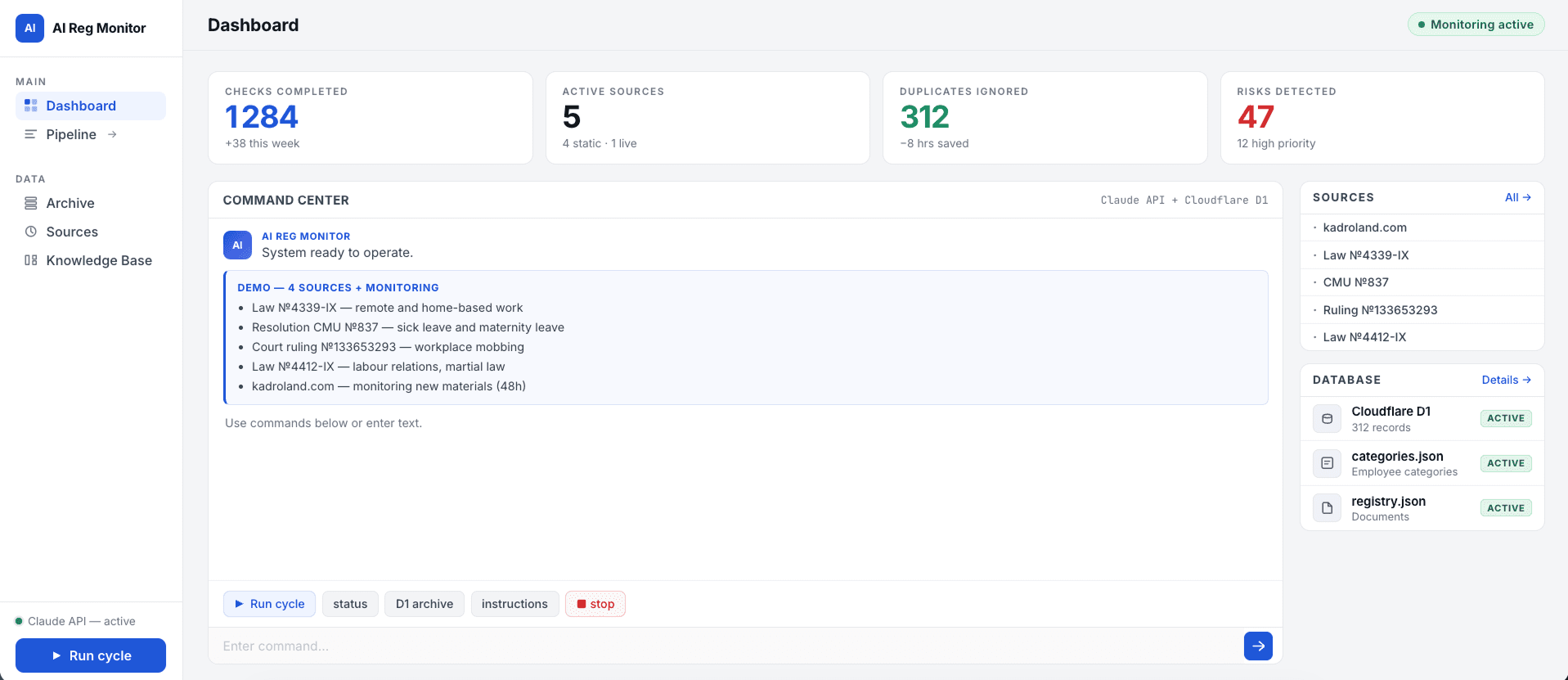
Tech Stack
OUTCOME
Measurable operational improvement.
↓ 83%
Reduction in daily monitoring time
~1 day
Per week reclaimed per team member
↓ Spend
External advisory costs for routine monitoring
Time Efficiency
Monitoring time reduced from over 1 hour to approximately 10 minutes per day. Each team member now reclaims nearly one full working day per week, redirected to higher-value legal work.
Cost Efficiency
Reduced dependency on external advisory services for routine regulatory scanning. The in-house team now handles monitoring internally at a fraction of the previous cost.
Operational Improvement
Regulatory updates are disseminated faster and with greater consistency. The legal team operates with a clearer, structured view of the regulatory landscape, without increasing headcount.
Ready to automate?
Wondering how it can work in your legal team?
Book an intro call to explore what's possible for your team.